1. FUNDAMENTAL ASSESSMENT
The Nasdaq Composite is operating within a market environment characterized by pronounced risk aversion, fueled by critical geopolitical tensions in the Middle East. Recent political statements and incidents in the region have triggered a sharp rise in energy prices, posing a direct inflationary risk and weighing on growth prospects. The market fluctuates, driven by headlines, between fears of escalation and hopes of de-escalation, creating a high volatility regime. This uncertain environment renders risk assets, particularly Nasdaq technology stocks, especially vulnerable to exogenous shocks.
2. TECHNICAL DYNAMICS
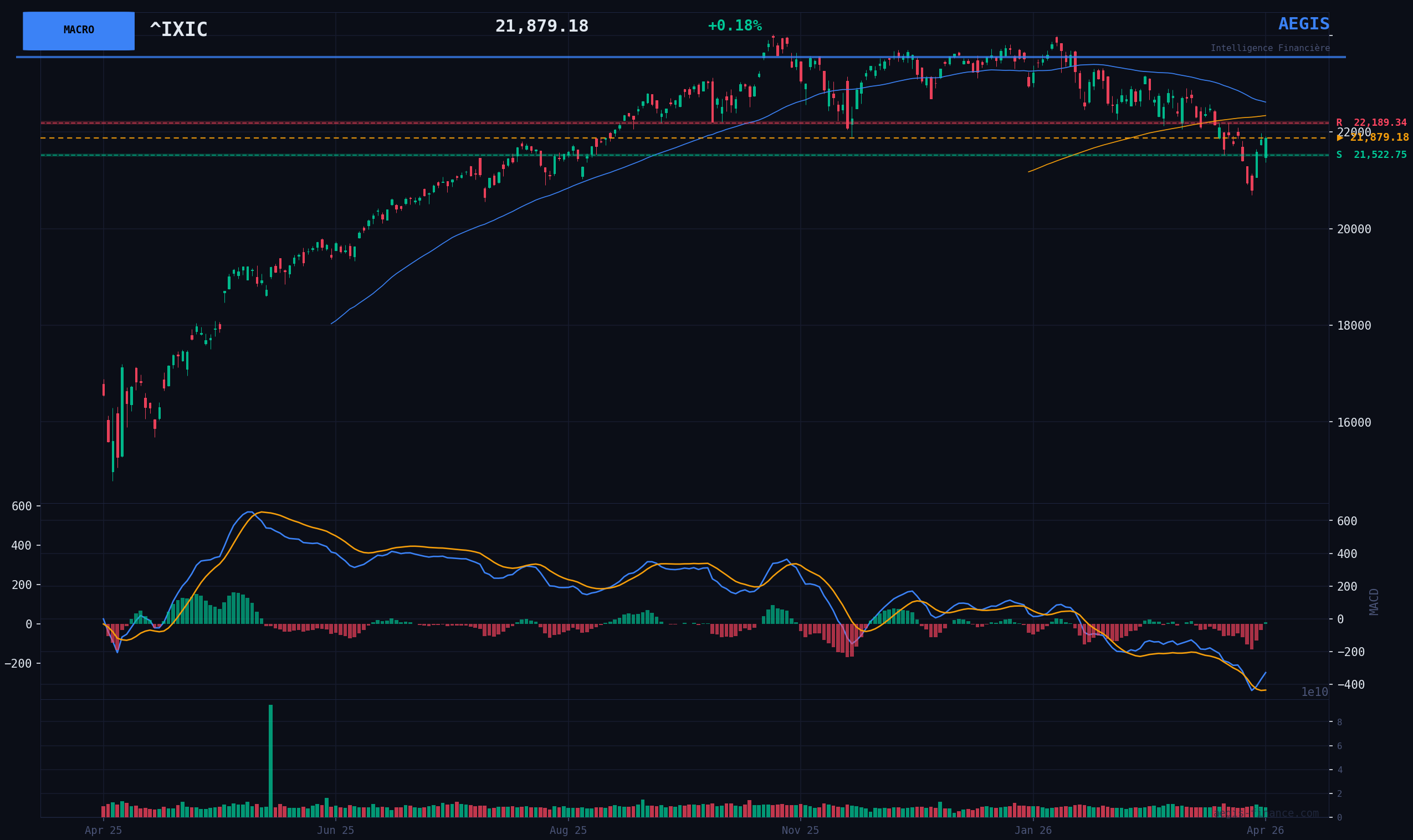
Technically, the structure of the Nasdaq Composite is precarious. The index is currently trading below its key 20-day (21988 pts) and 200-day (22340 pts) moving averages, signaling an underlying BEARISH dynamic. The RSI at 47.23, while not oversold, is below the neutrality threshold of 50, indicating an absence of buying momentum. Despite a technical rebound over the last three sessions, volumes do not show strong conviction (91% of the average). The major support level at 20690 pts represents the next critical defense zone, while the 22340-22500 pts area acts as a significant technical resistance.
3. SCENARIOS & MACROECONOMIC CATALYSTS
The market regime is in 'TRANSITION', characterized by an absence of clear trend and high reactivity to news. The VIX, at 23.87, confirms a high level of tension that is compressing valuations. Geopolitical risk, assessed as critical, is the primary driving factor.
- BEARISH Scenario (55% probability): A further escalation of tensions in the Middle East or a persistent surge in oil prices above 115$ per barrel would trigger a wave of selling. A break of the 20690 pts support would open the way for a deeper correction.
- Base Scenario (35% probability): The conflict remains contained, but uncertainty persists. The index oscillates within a consolidation range between the 20690 pts support and the SMA200 resistance around 22340 pts, with high volatility dictated by information flows.
- BULLISH Scenario (10% probability): A credible de-escalation agreement and a drop in the VIX below the 20 threshold would be necessary. This catalyst, deemed unlikely in the short term, would allow the index to break above its SMA200 and target the 23170 pts resistance.
4. AEGIS VERDICT
In a 'TRANSITION' market regime and a critical geopolitical risk context, this BEARISH signal on the Nasdaq Composite is a protective strategy against high volatility and a degraded technical structure. A R/R ratio of 2.02:1 is required to compensate for the dominant macro risk. The signal is triggered by a rejection below the SMA20 (currently 21988 pts) confirmed by a BEARISH daily close. The first target (TP1) is set at 21000 pts for partial profit-taking, with a final target at 20690 pts. The protective stop is placed at 22500 pts. Recommended sizing: Reduced position (0.5x).